

In January 2025, one of West Africa’s most important gold-mining complexes stopped operating. The conflict was not caused by a collapse in global demand for gold. It emerged from a struggle over who should control—and profit from—the deposits beneath Malian soil. On one side stood Mali’s government, determined to secure a larger share of mining revenue. On the other stood Barrick Mining and its operating subsidiaries, defending the contractual framework governing their investment at Loulo–Gounkoto.
This was not an abstract debate about resource nationalism. Gold shipments were restricted, mine employees were detained in the course of the dispute, international arbitration was initiated, and a Malian court ordered provisional administration of the complex. Following a negotiated settlement in November 2025, operational control returned to Barrick’s subsidiaries in December.
The episode provides an unusually concrete demonstration of a central problem in political economy: a government can increase its claim on an existing mine and, simultaneously, weaken the economic incentives needed to keep it productive and attract future investment.
The question is not simply whether Mali obtained more revenue. It is whether the gains exceeded the fiscal, productive and social costs—and whether the resulting public funds reached citizens.
1. What did Mali change and who actually owned the mine?
Mining accounts for approximately 10% of Mali’s GDP, more than 80% of exports and roughly one-quarter of government fiscal revenue, according to the IMF’s 2025 assessment. Such dependence creates a powerful incentive to renegotiate the distribution of mineral rents. It also makes interruptions unusually costly.
The 2023 Mining Code, followed by implementing provisions in 2024, permits a 10% non-contributory state interest in new mining projects, an option to acquire a further 20%, and another 5% available for Malian private investors. The combined domestic interest can therefore reach 35%.
That figure must not be confused with the ownership structure of every existing mine.
At Loulo–Gounkoto, Barrick reported that its subsidiaries held 80% and the Malian government 20% before the temporary administration. Nor was the court-appointed administration a permanent transfer of legal ownership to the state.
The dispute also concerned the existing mining conventions. Mali sought revised fiscal terms; Barrick argued that the conventions’ stabilisation provisions protected its existing rights. The legality of the competing positions was contested, rather than conclusively established by the eventual settlement.
The immediate stakeholders were not only the two negotiators. Barrick’s shareholders, miners and contractors, nearby communities, and Mali’s taxpayers faced consequences without exercising equivalent control over the bargaining process.
2. The economics: higher fiscal receipts, lower production
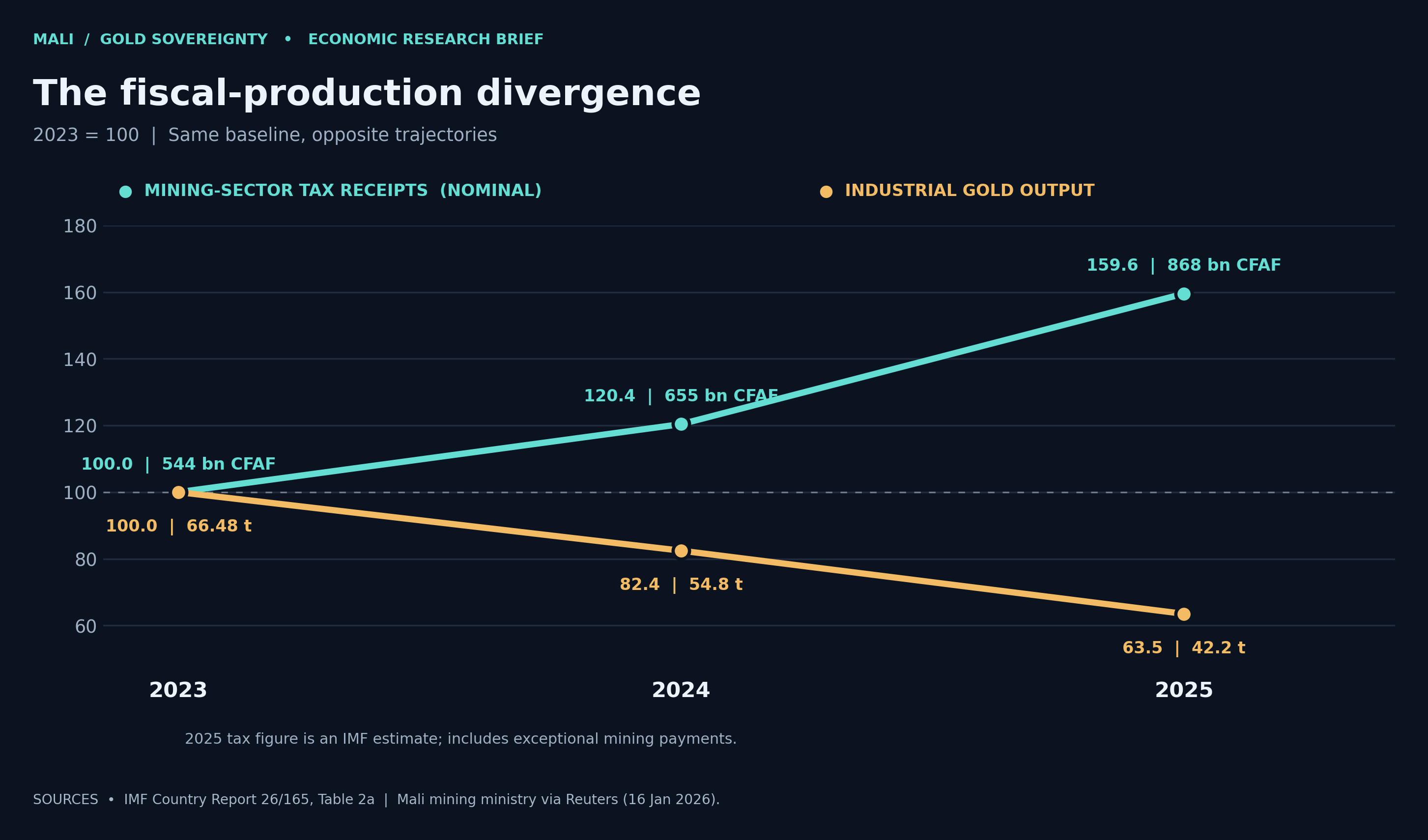
Figure 1. Both series are indexed to 2023 = 100. Nominal mining - sector tax receipts are not adjusted for inflation and the 2025 fiscal amount is an IMF estimate including exceptional payments.
Sources: IMF Country Report 26/165, Table 2a; Malian ministry figures reported by Reuters, 16 January 2026.
Mali’s industrial gold output contracted approximately 36.5% between 2023 and 2025, while estimated nominal mining-sector tax receipts increased approximately 59.6%.
This divergence cannot, by itself, establish an economic victory or a policy failure. A higher gold price, an altered tax base, better enforcement and exceptional settlements can lift receipts even when physical output declines. The two series also cover different concepts and should not be interpreted as a calculated effective tax rate.
The site-level data show just how concentrated the production shock was.
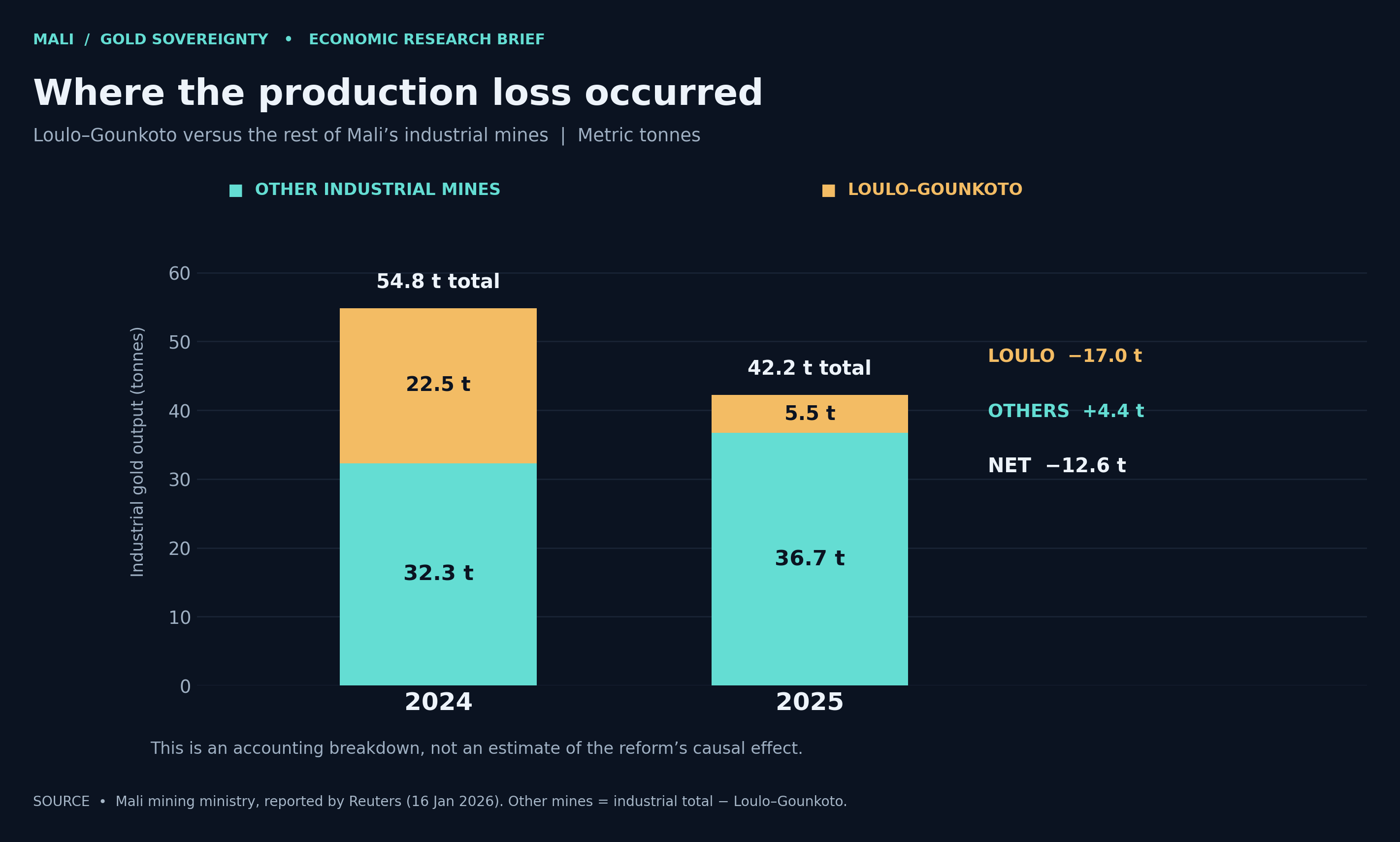
Figure 2. Accounting decomposition of industrial gold output, not a causal attribution.
Source: Malian ministry figures reported by Reuters, 16 January 2026.
Loulo–Gounkoto’s 17-tonne decline was larger than the national decline, partly offset by increases elsewhere. That establishes the location of the output collapse.
It does not imply that the entire difference was caused exclusively by the Mining Code: restrictions on gold shipments, managerial decisions, security conditions, fuel interruptions and other operational factors must be considered.
There was also a measurable fiscal opportunity cost. The IMF estimated that government revenue might have been CFAF 180 billion higher in 2025 if the shutdown of Mali’s largest gold mine had been avoided.
Barrick’s audited reporting separately records a settlement payment of approximately CFAF 143 billion in November 2025.
These are comparable in scale but not directly nettable: the former is a modelled annual counterfactual; the latter is one component of a negotiated settlement and may be reflected in recorded receipts. Treating their simple difference as the national gain or loss would be analytically wrong.
3. Game theory with real players: Mali’s government versus Barrick
The logic of the conflict becomes clearer when the actors’ strategic options are specified. This was a sequential bargaining game, not a simultaneous decision in which each side chose a strategy once and for all.
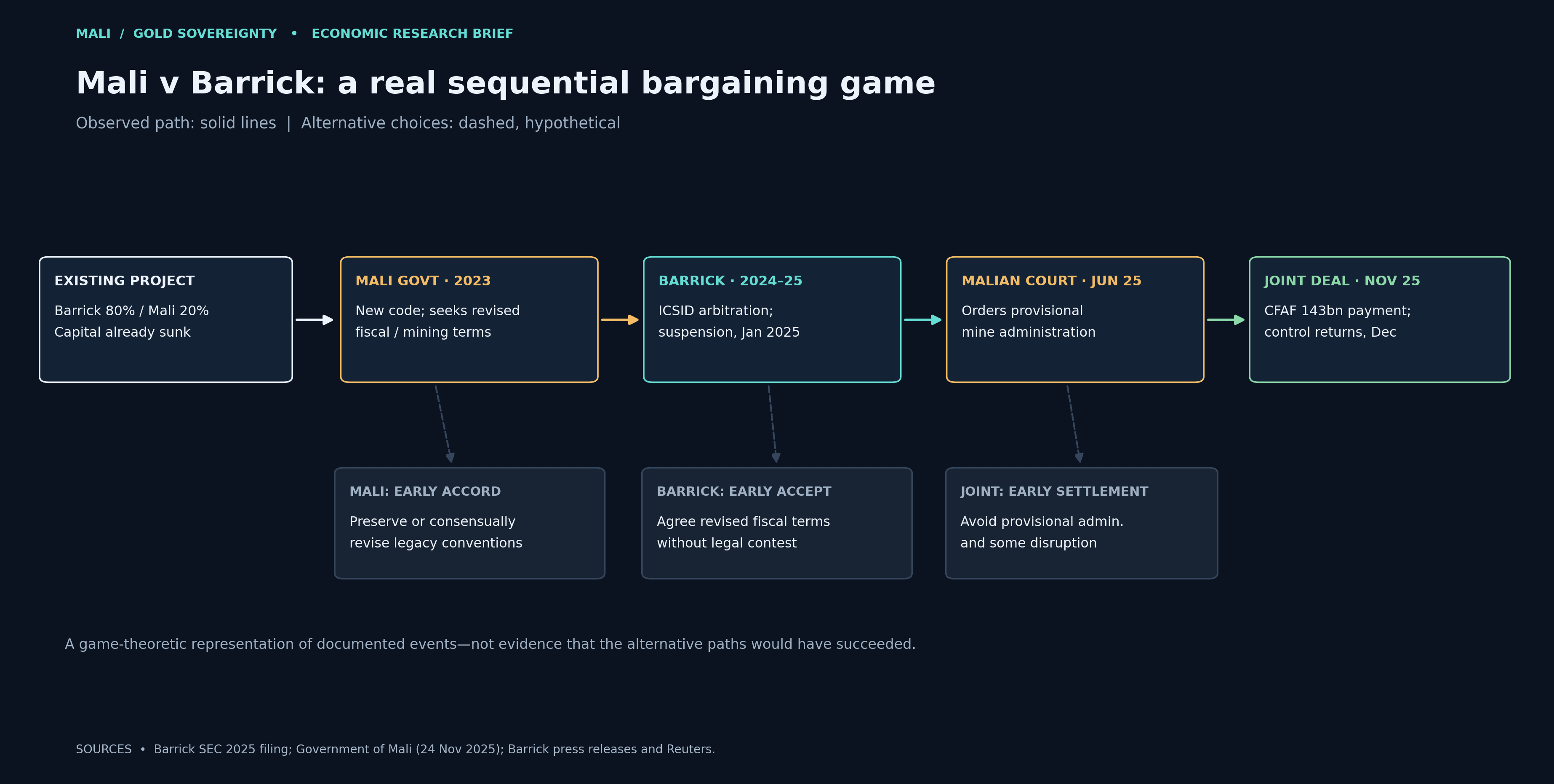
Figure 3. The upper path traces documented actions; the dashed branches are analytically possible alternatives, not observed outcomes.
Sources: Barrick’s 2025 financial statements; Barrick announcements; the Malian government’s statement of 24 November 2025.
Stage 0: Barrick’s capital was already committed
Loulo–Gounkoto had costly, location-specific infrastructure, engineering capabilities and ore-processing facilities. Barrick could not simply move a gold deposit to another country.
That is why the state’s bargaining position becomes stronger after a mine is built than before an investment is made.
Stage 1: Mali increased its fiscal claims
Through the 2023 reforms and review of existing conventions, the government pursued greater fiscal returns and domestic participation.
Its strategic alternatives included negotiating revised terms in a manner accepted by both parties or intensifying enforcement and fiscal demands. In practice, the disagreement over the application of revised terms escalated.
Stage 2: Barrick chose legal contestation rather than unconditional acceptance
Barrick’s subsidiaries initiated proceedings at the International Centre for Settlement of Investment Disputes (ICSID) in December 2024.
After restrictions on gold exports and attachment of gold stocks, Barrick announced a suspension of operations on 14 January 2025.
The company’s investment was sunk, but it retained strategic options: pursue arbitration, withhold further commitments, negotiate, or suspend operations under the circumstances it described.
Stage 3: Malian institutions escalated their intervention
On 16 June 2025, Bamako’s Commercial Tribunal ordered provisional administration at the request of the government.
The arrangement shifted operational control temporarily without extinguishing Barrick’s equity interest. The state gained leverage, but the mine’s contribution to production and recurring fiscal flows was severely disrupted.
Stage 4: Both parties reached a settlement
On 24 November 2025, Mali and Barrick announced an agreement ending the disputes.
Barrick’s subsidiaries undertook to withdraw arbitration; the government agreed to terminate provisional administration and drop charges.
Barrick reported the approximately CFAF 143 billion payment, and operating control was restored on 16 December.
The settlement did not establish that either party’s earlier legal interpretation had been objectively correct.
This sequence reveals more than a bargaining disagreement. Mali controlled critical regulatory and enforcement instruments; Barrick controlled specialised expertise, could pursue investor–state arbitration and could limit operations in response to restrictions.
Each party could impose costs on the other, but neither could unilaterally capture the full value of the gold deposit without the other’s cooperation.
A strategic payoff matrix for Mali and Barrick
A deliberately simplified one-shot payoff matrix makes the strategic tension explicit.
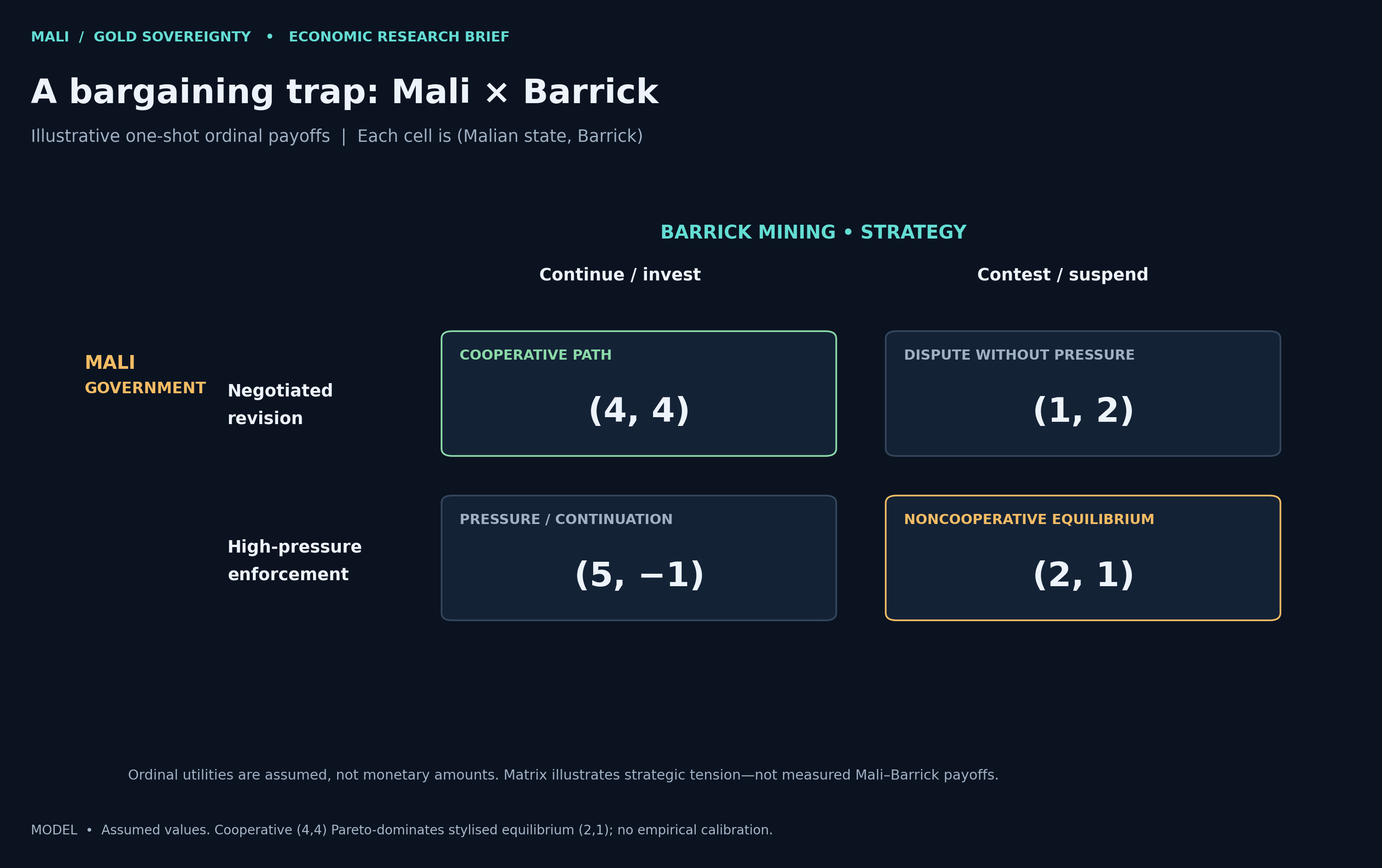
Note: Payoffs are assumed ordinal utilities, written (Malian government, Barrick). They are not observed financial returns.
Under these illustrative assumptions, high-pressure enforcement is Mali’s preferred strategy regardless of Barrick’s initial choice.
If Mali pursues aggressive enforcement, Barrick prefers contestation to an unconditionally loss-making continuation.
The resulting non-cooperative Nash equilibrium is therefore (high-pressure enforcement, contestation) with utilities (2, 1).
Yet both players would prefer negotiated revision and continued investment, yielding (4, 4).
The model reveals a potential bargaining trap: unilateral strategies that appear individually rational can generate an outcome that is collectively inferior.
It does not establish that Mali’s government actually maximised the assumed payoff function, that Barrick’s actions were legally justified, or that the observed historical dispute can be reduced to four numerical outcomes.
The eventual 2025 settlement demonstrates the importance of continued negotiations beyond this simplified one-shot game.
4. Why the bargaining problem reappears at the next mine
The theoretical concept is the obsolescing bargain, closely related to the hold-up problem.
Mining capital is expensive to install and relatively difficult to redeploy.
This creates a time-inconsistency problem: a government can find it attractive to demand more once capital is sunk even when it would have preferred to promise stability before the investment.
A simple representation makes the trade-off explicit.
Let the Malian government’s expected payoff from a particular bargaining strategy be:
U_M = expected taxes + dividends + settlements − lost future receipts − legal/enforcement costs + political benefits
For Barrick, the relevant payoff is:
U_B = discounted after-tax operating cash flow − new capital expenditure − dispute costs − interruption costs
These are analytical payoff functions, not empirically estimated accounts.
Political benefits need not be identical to citizens’ economic welfare.
For example, a government can gain political credit for a highly publicised payment even if the country’s future investment base deteriorates; a corporation can defend shareholders’ property rights without necessarily maximising local employment or environmental welfare.
The investor’s future expansion decision can be written as a threshold:
Invest if E[discounted after-tax project cash flow] ≥ required upfront investment + risk premium
The government’s more aggressive bargaining strategy becomes attractive ex post if expected additional collections and political gains outweigh the production, enforcement, legal and reputational costs it anticipates.
Because both sides are uncertain about these costs and because they learn during conflict, protracted bargaining can occur even when an earlier agreement might have saved resources.
The important conclusion is not that higher government taxes are intrinsically bad.
A higher but credible and predictable tax burden can coexist with investment.
What matters is the combined effect of the expected fiscal burden, contractual uncertainty and the probability of repeated renegotiation.
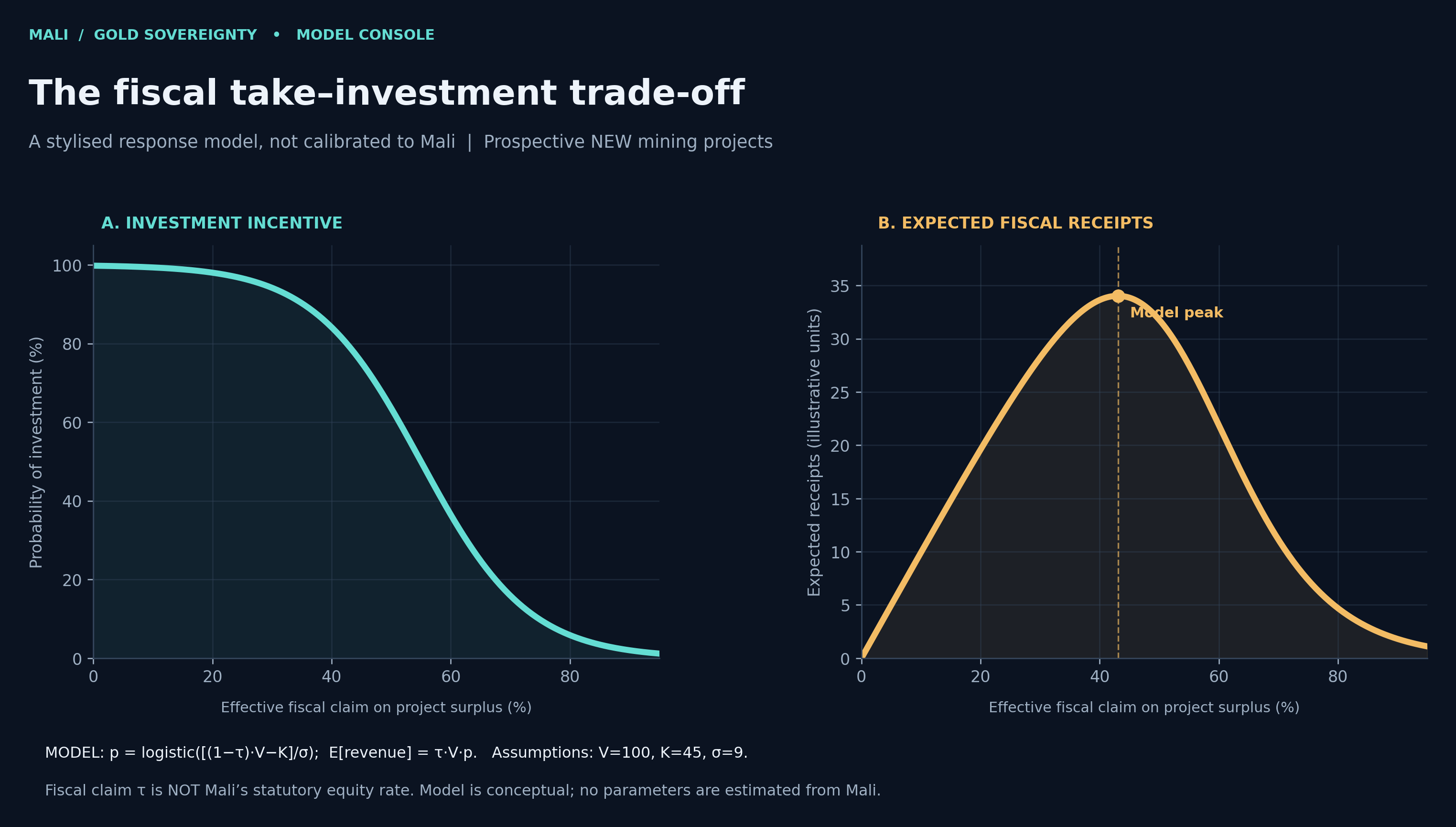
Figure 4. Stylised comparative-statics illustration, not a regression or estimate for Mali. The fiscal-claim variable is an illustrative share of project operating surplus and is not the 35% equity provision of Mali’s Mining Code. All curve parameters are assumed and supplied in the editable dataset.
In the model, raising the government’s claim initially increases expected revenue.
Beyond a point, if prospective investors expect materially lower after-tax returns, fewer projects are undertaken and the expected future revenue base can shrink.
The peak is a property of the model’s assumptions; no “optimal Malian tax rate” can be inferred from it.
For Mali, the empirical test would be whether the revised rules deliver durable tax and dividend income while preserving exploration expenditure, reserve replacement, mining employment and investment in future projects.
The short post-2023 observation window makes this a research question, not an established conclusion.
5. A third player with weak bargaining power: Malian citizens
The corporate and governmental payoff functions leave out a constituency whose welfare ought ultimately to matter most.
Citizens possess a collective claim to public mineral wealth, but ordinary households do not directly negotiate royalty schedules or mine operating agreements.
The state is supposed to represent them; it may not always share their preferences.
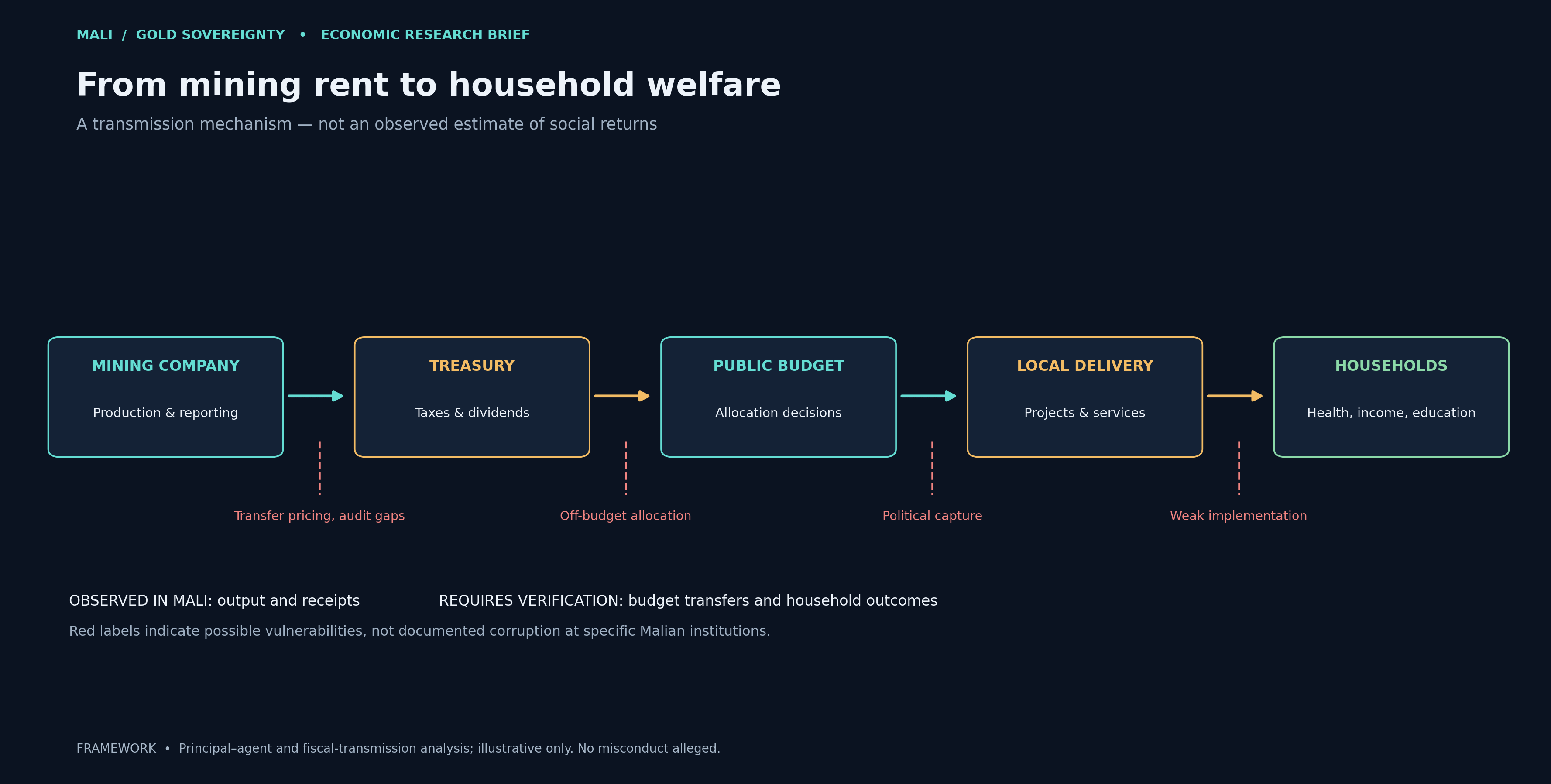
Figure 5. Conceptual fiscal-transmission diagram. Possible integrity failures are risks to test, not allegations of documented misconduct by identified parties.
The crucial economic question is how much additional mining revenue becomes verifiable public value.
A payment may enter the treasury without reaching mining communities.
Funds may be allocated to infrastructure but not disbursed, a project may be financed but not completed, a hospital may be built without staff or medicines.
Conversely, properly managed mineral income can finance essential public goods that a private firm would have little incentive to supply voluntarily.
Corruption risk enters at several stages: reporting of production, collection of taxes, allocation of expenditure, procurement and local service delivery.
Private ownership does not eliminate these risks, and state participation does not automatically solve them.
Nor does the existence of a risk prove wrongdoing in Mali’s case.
A credible welfare assessment would require independently observable data on budget transfers, actual project spending, employment, compensation, education, health, household consumption and environmental outcomes.
The Extractive Industries Transparency Initiative, corporate financial reporting, national budgets and local surveys offer possible starting points, but the evidence remains incomplete.
6. Preliminary verdict: a harder bargain, not yet a demonstrated development dividend
The government obtained meaningful near-term fiscal receipts and negotiated a settlement after a highly visible standoff.
At the same time, the largest mine’s output fell sharply, and the IMF identified significant fiscal receipts potentially lost because of the shutdown.
By October 2026, the available evidence does not support a confident claim that the 2023 reforms increased Mali’s net national welfare or reduced poverty.
The economic lesson is subtler than a verdict for or against resource nationalism.
Mali has legitimate reasons to seek a larger return from finite resources, while investors require a credible basis for recovering sunk capital.
The two objectives are not mutually exclusive: good institutions can support both.
But the mechanisms of rent capture and welfare distribution must be analysed separately.
The Loulo–Gounkoto dispute shows why.
It was possible for the government to emerge with a substantial payment while the country experienced a major production contraction.
The true development test is whether such gains become a reliable stream of investment-compatible public revenue and are transformed into better lives for citizens.
Next in Part II: Tanzania’s post-2017 mining reforms and Ghana’s earlier investment-led expansion provide historical evidence on how governments can raise receipts or production—and why neither achievement alone proves that mining communities are better off.
References
IMF (2026): Mali, Second Review Under the Staff-Monitored Program
Barrick Mining (June 2025): Arbitration and Provisional Administration
Government of Mali (November 2025): Loulo–Gounkoto Settlement
Methodological note: The historical figures and documented decisions are distinguished throughout from modelled payoffs and counterfactual outcomes. Correlation over the reform period does not by itself establish causation.